Haverford Roofing provides commercial roofing in Haverford, PA, serving surrounding cities including Uwchlan, Yeadon, West Bradford, Upper Providence Township, Nether Providence. Over 20+ years we have worked on the small and mid-size buildings that make up most of the Main Line’s commercial stock: storefronts with flat roofs behind a parapet, offices, churches, apartment buildings and condominium communities.
Commercial roofs are a different job from houses. Most are low-slope membranes, they carry rooftop equipment and drains, and the work has to happen around tenants, customers and residents who still need the building open.
We give owners and managers the same thing we give homeowners: a straight answer on whether the roof can be repaired, and a written scope that lists tear-off, insulation, membrane, flashing and drainage as separate lines. That makes the estimate easy to compare and easy to take to a board.
Commercial Roofing Systems
TPO and PVC Single-Ply Membranes
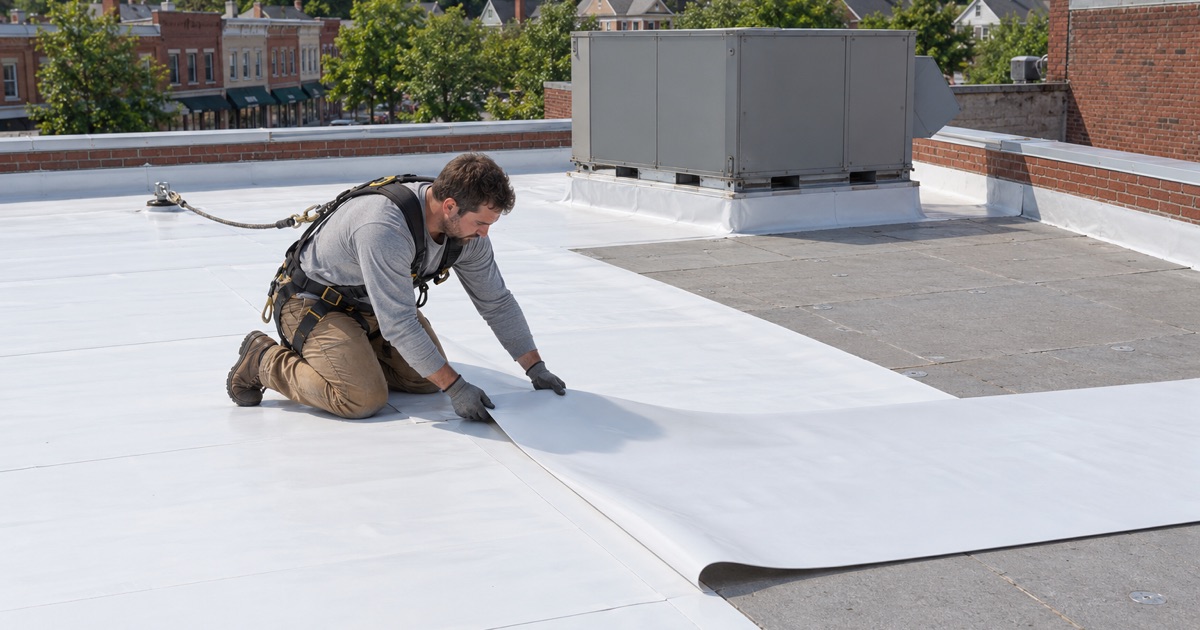
TPO and PVC are single-ply membranes with heat-welded seams. White TPO reflects summer heat, which helps buildings with rooftop units and top-floor offices stay cooler.
Welded seams become one continuous sheet when done right, so seam quality is everything. We probe every seam after welding and repair any that are not fully fused before the job is closed out.
EPDM Rubber Membranes
EPDM rubber has been used on low-slope roofs for decades. It goes down in large sheets with few seams and stays flexible through cold winters.
We repair aging EPDM by cleaning and re-bonding open seams, patching punctures and replacing failed flashing at walls and curbs. When the membrane has shrunk away from its edges or cracked across the field, replacement becomes the better value.
Torch-Down Modified Bitumen
Modified bitumen, in SBS or APP formulations, is built up in layers and holds up well to foot traffic around mechanical equipment. Many older commercial and multifamily roofs in the area are modified bitumen.
Torch-applied work follows Haverford’s permit addendum: a fire extinguisher stays on the roof, and propane tanks come down at the end of each working day. Where torching is not appropriate near a wall or a combustible detail, we use self-adhered or cold-applied plies instead.
Common Commercial Roof Problems
Ponding Water and Drainage
Water that stands on a flat roof for days after rain shortens the life of any membrane. It usually points to clogged drains, sagging deck sections or insulation that was never tapered toward the outlets.
We clear and check drains and scuppers, map where water stands, and add tapered insulation or crickets during a replacement so the roof actually drains. A roof that drains well is a roof whose seams stay dry between storms.
Parapet Walls, Curbs and Penetrations
Most commercial leaks start at the edges and openings rather than the open field: parapet walls, coping caps, HVAC curbs, vent pipes and skylights. These are the places where the membrane turns up and has to be flashed.
We rebuild wall and curb flashing with membrane turned up and properly terminated, and replace failed coping where water is entering the top of the parapet. These edge repairs stop most commercial leaks without touching the rest of the membrane.
Rooftop Equipment and Foot Traffic
HVAC technicians, satellite installers and maintenance crews all walk on commercial roofs, and each trip can puncture or scuff the membrane. Damage often goes unnoticed until it leaks.
We add walkway pads along service routes and around equipment, and recommend periodic inspections so punctures are found while they are still small repairs. Asking service contractors to stay on the pads protects the roof between visits.
Buildings We Work On
Storefronts and Mixed-Use Buildings
Main street buildings often have a flat roof behind a parapet, with apartments or offices above a shop. Leaks there reach tenants and inventory quickly, so response and clear communication matter.
We schedule work to keep storefronts open and entrances clear, and we close the roof watertight at the end of each day so nobody downstairs is caught by an overnight storm.
Churches and Older Institutional Buildings
Churches and older institutional buildings often combine steep slate or metal roofs with flat sections, box gutters and complicated flashing at towers and parapets. Repairs need patience and the right materials.
We repair slate with copper nails and slate hooks, reline box gutters, and keep original copper where it is still sound, so the building’s character survives the repair. Flat sections behind parapets get the same membrane care as any commercial roof.
Apartments, Condominiums and Associations
For multifamily buildings and community associations, the roof is usually a shared expense governed by the declaration under Pennsylvania’s Uniform Condominium Act or Uniform Planned Community Act. Boards need a scope they can vote on and residents need notice.
We provide a line-item scope, photos of current conditions, certificates of insurance and a schedule that can be shared with residents. Where a building has several roofs, we can phase the work to match the association’s budget.
Permits, Safety and Insurance
Township Permits and Contractor Registration
Commercial re-roofing requires a permit in most townships around Haverford, and some add their own rules for contractors. East Whiteland, for example, requires every contractor on a commercial site to register with the township.
We confirm the requirements for your building’s township before pricing, and permit fees appear as their own line on the estimate. Nothing starts until the permit is posted on site.
Fall Protection and Site Safety
Commercial roofs often have open edges, skylights and roof hatches. We set guardrails, warning lines or personal fall arrest as the roof requires, and keep work areas clear of tenants and customers.
Certificates of insurance, including workers’ compensation, are provided before work starts, naming the owner or management company as requested. Managers can keep them on file with the building’s other vendor records.
Upgrades and Ongoing Care
Insulation During a Replacement
A full tear-off is the cheapest moment to improve a flat roof’s insulation, because the deck is already exposed. Rigid insulation boards go down under the new membrane, and tapered boards can be added at the same time to move water toward the drains.
We price insulation as its own line, so you can see the cost of the upgrade separately from the roof itself. On top-floor apartments and offices, the difference is often felt in the first summer.
Inspection and Maintenance Plans
Commercial roofs last longest when someone looks at them regularly. A spring and fall inspection catches clogged drains, punctures from service traffic and seams beginning to open while they are still small repairs.
We document each visit with photos and a short written report, so owners and boards have a running record of the roof’s condition when they plan budgets and reserves. Small repairs found on those visits are priced separately and only made with your approval.
- 20+ Years in Business
- Attic Checked on Every Leak
- Line-Item Written Scopes