
Haverford Roofing provides flat roof repair in Haverford, PA, serving surrounding cities including Uwchlan, Yeadon, West Bradford, Upper Providence Township, Nether Providence. Most of the flat roofs we repair are not on commercial buildings but on houses: the rear addition off the kitchen, the porch roof below the bedroom windows, the garage, and the shed dormer with almost no pitch.
After 20+ years of roofing on houses like these, we know where low-slope roofs leak. It is almost always at an edge or a joint, where the membrane meets a wall, a drain, a chimney or the shingle roof above, rather than in the middle of the sheet.
That is why every flat roof repair starts with finding the joint that failed and looking at how water drains off the roof. You get a straight answer on whether a repair will last, and a written scope that lists what we are fixing and why.
Flat Roof Materials We Repair
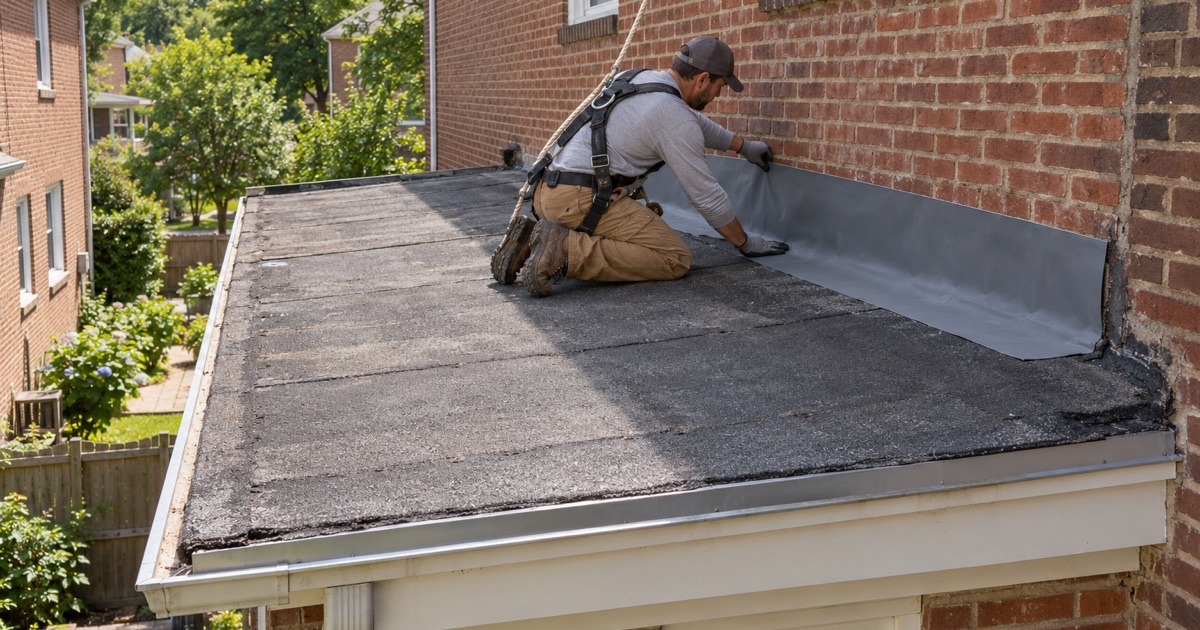
Torch-Down Modified Bitumen
Modified bitumen, in SBS or APP formulations, is the most common material on older residential flat roofs here. It goes down in overlapping rolls, usually torch-applied, with a granular cap sheet on top.
It fails at the laps between rolls, at blisters where moisture trapped underneath has expanded, and where the granules wear away and the asphalt underneath dries out. We repair laps and blisters with compatible material, and we use self-adhered plies instead of a torch near wood trim.
EPDM Rubber Roofing
EPDM is a black rubber membrane installed in large sheets, often on additions and dormers. It stays flexible in the cold and has few seams.
As it ages, the seams can let go and the sheet can shrink and pull away from the edges and walls. We clean and re-bond open seams with the correct primer and tape, and replace flashing that has pulled loose.
TPO Single-Ply Membranes
TPO is a white single-ply membrane with heat-welded seams, common on newer additions and on roofs where reflecting summer heat matters. Done right, the welds create one continuous sheet.
Repairs are welded patches of matching TPO. Older TPO can be difficult to weld if its surface has weathered, so we test and clean the area first and tell you if a section needs replacing instead.
Where Flat Roofs Leak
The Wall Joint
Where a flat roof meets the house wall, the membrane has to turn up the wall several inches and be covered by counter flashing, siding or a termination bar. When the original installer simply sealed the joint with roofing cement, that seal cracks within a few seasons.
We rebuild the wall joint properly, turning new membrane up the wall and covering it with flashing tied into the siding or set into the masonry. It is the single most common repair we make on residential flat roofs.
Seams, Laps and Blisters
Open seams let water travel under the membrane, sometimes far from the leak inside. Blisters form when trapped moisture expands in the heat, and a broken blister becomes an opening.
We cut out damaged blisters, dry and patch the area, and re-bond or re-weld seams along their full length rather than patching only the spot that was dripping. Water that traveled under a seam often entered well away from where it appeared inside.
Drains, Scuppers and Gutters
Small residential flat roofs usually drain off one edge into a gutter or through a scupper in a parapet. Leaves and grit clog those outlets, and water backs up until it finds a weak seam.
We clear and check the outlets, repair the flashing around them and make sure the gutter below is sized and pitched to take the flow. A flat roof that cannot drain will not stay dry for long, whatever it is made of.
Where Flat Meets Pitched Roof
Many houses have a flat roof section tucked against the bottom of a shingle slope or a dormer. Water from the steep roof pours onto the flat section at full speed, and the transition between materials is a common leak point.
We make sure the shingle roof’s edge laps over the flat roof membrane correctly, add ice and water barrier at the transition, and protect the membrane where the heaviest water lands.
Ponding Water and Slope
Why Ponding Matters
Water that sits on a flat roof for days after rain keeps seams wet, adds weight and speeds up the aging of every membrane. Over time it also finds the smallest weakness in a lap or a patch.
Ponding usually comes from a sagging deck, a clogged outlet or a roof that was never sloped properly. Haverford’s roof addendum treats anything below 4:12 as low slope, and most flat roofs here have far less pitch than that.
Fixing Drainage During a Repair
Where water stands near an outlet, clearing and resetting the drain may be enough. Where it collects in the middle of the roof, the long-term answer is tapered insulation or a cricket that moves water to the edge.
We tell you whether drainage can be improved as part of a repair or whether it is the reason to replace that section. Repairing a membrane that will sit under water again next week is not money well spent.
Repair or Replace a Flat Roof
When a Repair Makes Sense
If the membrane is mostly sound and the leaks come from a few seams, the wall joint or an outlet, a repair is the right answer. We say so even if the roof is older.
When Replacement Is Better
If the membrane is cracked across the field, blisters are everywhere, or the insulation and deck underneath are wet, patching will only chase leaks. In that case we price a replacement section by section, showing you photos of what we found, and any damaged decking is shown to you before it is replaced.
- 20+ Years in Business
- Attic Checked on Every Leak
- Line-Item Written Scopes